

Hospital-Grade Power Strips for IV Poles: What Biomedical Teams Should Know
Modern hospitals rely on an increasing number of powered medical devices to support patient care. Infusion pumps, patient monitors, and other equipment often share limited space in patient rooms, emergency departments, and critical care areas. As more devices are added to mobile equipment configurations, providing organized and accessible electrical power becomes increasingly important.
Hospital-grade power strips designed for IV pole mounting offer a practical way to manage electrical connections while reducing cord clutter around medical equipment. By securing power strips directly to IV poles, healthcare facilities can create more organized equipment configurations and improve access to electrical connections. For biomedical engineering teams, selecting an appropriate medical-grade power strip involves evaluating electrical requirements, mounting options, equipment compatibility, and the facility’s established safety procedures.
Why Power Management Matters in Hospital Environments
Mobile medical equipment frequently moves between patient rooms, treatment areas, and hospital departments. IV poles may support multiple infusion pumps and other powered devices, each requiring a reliable electrical connection. Without an organized power management system, electrical cords can become difficult to manage. Long cables may hang loosely, interfere with equipment movement, or create additional obstacles around patient care areas.
Common power management challenges include:
- Limited access to appropriately located electrical outlets
- Multiple power cords attached to a single mobile equipment configuration
- Loose cables that interfere with equipment movement
- Inconsistent power strip placement between departments
- Difficulty identifying and accessing individual electrical connections
A properly configured IV pole-mounted power strip can help address these organizational challenges by providing a designated location for electrical connections. However, power strips used with medical equipment must be selected and installed according to applicable electrical safety requirements and hospital policies.
Understanding Hospital-Grade Power Strips and UL 1363A
Not all power strips are suitable for use with medical equipment. Healthcare facilities must consider the intended application, equipment configuration, and applicable electrical safety standards before selecting a power distribution solution. UL 1363A addresses special-purpose relocatable power taps intended for specific medical equipment assemblies. These devices are designed to supply power to multiple electrical components within compatible movable medical equipment configurations.
Importantly, selecting a UL 1363A product does not automatically make every installation compliant. Power strips used within the patient care vicinity are subject to additional requirements concerning permanent attachment to compatible equipment assemblies, electrical loading, installation by qualified personnel, and ongoing inspection. Biomedical engineering departments should verify product specifications, applicable requirements, equipment compatibility, and facility procedures before approving a power strip installation.
Advantages of Mounting Power Strips Directly to IV Poles
An IV pole-mounted power strip creates a consistent location for electrical connections while keeping the power distribution equipment associated with the devices it supports. Instead of leaving power strips loose on equipment trays or other surfaces, a dedicated mounting system secures the unit directly to the pole. This configuration offers several practical advantages.
Improved Equipment Organization
Mounting the power strip to the IV pole allows power cords to be routed around a defined equipment configuration. This helps reduce loose connections and makes it easier for staff to identify which devices are connected. Consistent placement can also simplify equipment preparation and routine inspections.
Better Accessibility
A properly positioned power strip provides convenient access to electrical connections without requiring staff to search behind equipment or move unrelated supplies. The mounting location should allow access to outlets while protecting cords from excessive tension and avoiding interference with device controls or tubing.
More Efficient Equipment Movement
An organized power configuration can make mobile IV pole setups easier to manage during repositioning and patient transfers. Keeping the power strip securely mounted reduces unnecessary movement of the electrical components. Appropriate cord routing can also help prevent cables from becoming tangled around other equipment.
Choosing the Right IV Pole Power Strip
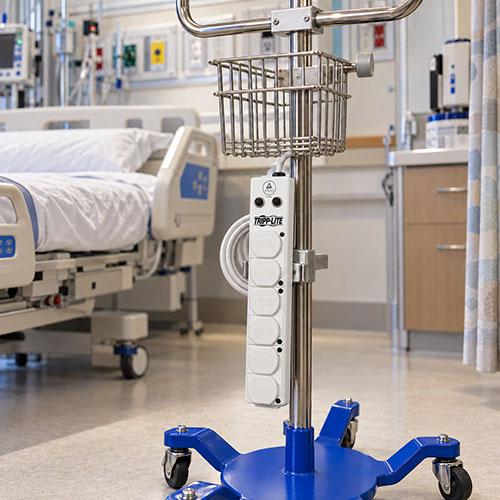
Hospitals should evaluate several factors when selecting a power strip for mobile medical equipment. The number of outlets, cord length, mounting hardware, and compatibility with existing IV poles can all influence the suitability of a particular product. Secure Mount’s IV Pole Stationary 6 Port Power Strip is designed to provide accessible power connections directly on compatible hospital IV poles.
The system includes a UL 1363A medical-grade power strip featuring six hospital-grade covered outlets and a 15-foot power cord. An anodized aluminum mounting bracket and pole clamp provide secure attachment to the pole. Facilities can choose between universal and quick-release clamp options based on their equipment configurations and mounting preferences. These features allow biomedical teams to evaluate a consistent power distribution arrangement for compatible IV pole setups while maintaining flexibility across different equipment configurations.
Mounting Hardware and Equipment Compatibility
The mounting system is an important consideration when selecting hospital IV pole accessories. A power strip must remain securely positioned during normal equipment use without interfering with pumps, handles, storage baskets, or other attachments. The selected clamp should be compatible with the pole diameter and provide adequate clearance around existing equipment.
Secure Mount offers universal and quick-release clamp options for its IV pole power strip. These configurations allow facilities to select mounting hardware appropriate for their equipment fleet. Biomedical teams should evaluate the complete setup, including mounting positions, electrical connections, equipment weight, and mobility requirements, before installation.
Managing Power Cords on Mobile Medical Equipment
Installing a hospital-grade power strip is only one part of creating an organized electrical setup. Power cords must also be routed appropriately to prevent excessive slack, unnecessary tension, and interference with other equipment. Facilities should establish consistent procedures for arranging cords around infusion pumps, monitoring devices, power strips, and mounting accessories.
Effective cord management practices include keeping cables away from moving components, maintaining appropriate access to electrical connections, and inspecting cords for wear or damage. Power strips should not be overloaded or connected together in a chain. Biomedical personnel should verify the electrical requirements of connected devices and ensure that the complete equipment configuration complies with applicable standards and facility policies.
Standardizing IV Pole Power Management Across Departments
Large healthcare facilities frequently manage numerous IV poles equipped with different combinations of medical devices. Inconsistent power strip placement and cable routing can make equipment preparation and maintenance more complicated. Standardizing approved power management configurations can help biomedical engineering departments establish more predictable equipment setups.
Facilities may develop guidelines covering approved power strip models, mounting locations, compatible clamps, cord routing, electrical loading, and routine inspection procedures. Using consistent configurations can also simplify replacement accessory purchasing and make it easier for employees to recognize improperly arranged equipment.
Routine Inspection and Maintenance
Hospital power strips and mounting accessories should be included in established equipment maintenance programs. Biomedical teams should regularly inspect electrical cords, plugs, outlets, mounting brackets, and clamps for signs of damage or deterioration. They should also verify that the power strip remains properly secured and that connected equipment operates within approved electrical limits.
Inspection procedures should follow manufacturer instructions, applicable electrical requirements, and the facility’s equipment management policies. Proper installation and ongoing maintenance help preserve the reliability and organization of mobile medical equipment configurations.
Improve IV Pole Power Management With Secure Mount
Effective power management is an important part of maintaining organized hospital equipment. A properly selected and installed IV pole power strip provides a designated location for electrical connections while supporting consistent cable routing and equipment configurations. Secure Mount’s IV Pole Stationary 6 Port Power Strip combines six hospital-grade covered outlets, a 15-foot cord, durable mounting hardware, and multiple clamp options in a system designed for compatible hospital IV poles.
By incorporating appropriate power distribution equipment into standardized IV pole configurations, biomedical engineering departments can improve organization, simplify equipment inspections, and support more efficient clinical workflows. Contact Secure Mount to discuss hospital-grade IV pole power strips, mounting options, and medical equipment power management solutions for your healthcare facility.