

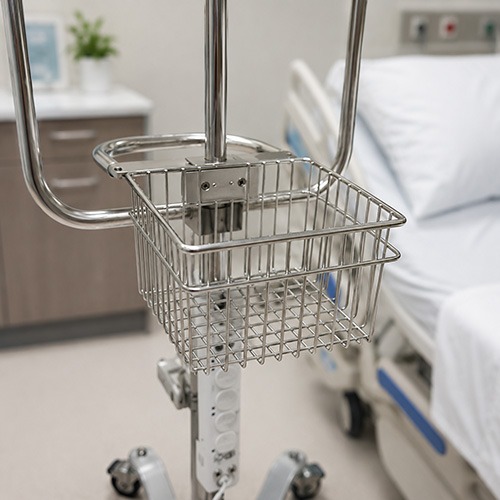
IV Pole Baskets and Medical Storage Baskets: Choosing the Right Option for Clinical Use
Hospitals rely on many small supplies, accessories, cables, and disposable items during patient care. Without a designated storage location, these items can create clutter around beds, treatment areas, and mobile equipment.
IV pole baskets and medical storage baskets help keep approved supplies organized and close to the point of use. Depending on the design, a basket may attach to an IV pole, equipment stand, cart, rail, or wall-mounted system. The right option can improve accessibility, support consistent equipment setups, and help staff make better use of limited clinical space.
Choosing a basket requires more than selecting a convenient size. Facilities should consider what it will hold, where it will be mounted, how it will be cleaned, and whether it could interfere with nearby devices, cables, or tubing.
What Is an IV Pole Basket?
An IV pole basket is a storage accessory designed to mount to an IV pole or compatible medical stand. It adds usable storage space without requiring a separate cart or cabinet.
Because the basket moves with the pole, it can keep selected supplies with the patient or equipment setup as the pole is repositioned. An IV pole basket may hold lightweight packaged supplies, cable-management accessories, monitoring components, personal items, or other materials approved by the facility.
It should remain easy to reach without blocking infusion pumps, power strips, controls, tubing, or the movement of the pole.
IV Pole Baskets vs. Other Medical Storage Baskets
Medical storage baskets are a broader category. Some are designed for IV poles, while others are intended for walls, rails, carts, workstations, or fixed storage systems.
The best option depends on whether the supplies need to move with the equipment. If the contents should remain with an infusion setup, an IV pole basket may be the better fit. If the supplies stay in one room or treatment area, a wall-mounted or equipment-mounted basket may provide a more stable location.
Start With the Intended Use
Before comparing materials or dimensions, determine exactly what the basket will hold. A basket intended for lightweight packaged items may have different requirements than one used for cables, accessories, or heavier components.
Consider the number and size of the items, their combined weight, access frequency, mobility needs, and whether small items could fall through the openings. Defining the application first reduces the risk of choosing a poorly suited basket.
Facilities should also determine whether the contents need to remain visible and whether employees must be able to access them while wearing gloves. A basket that works well in a biomedical equipment area may not be appropriate for the space and workflow of a patient room.
Choose the Right Size and Capacity
A basket should be large enough to hold the necessary items without becoming overcrowded. At the same time, an oversized basket can make an IV pole harder to maneuver or create an obstruction in a compact room.
Evaluate the basket’s dimensions and the clearance around the mounting point. Staff should be able to reach its contents without disturbing tubing, cables, pumps, or nearby equipment.
Load capacity is equally important. The basket, mounting hardware, IV pole, and pole base must all be suitable for the expected weight. Overloading a basket can affect stability, especially if other devices are already mounted on the same pole.
Staff may also begin placing unintended items into a basket that offers too much open space. Clearly defining the basket’s purpose and maximum load can help prevent it from becoming a catch-all storage area.
Evaluate the Mounting System
A pole-mounted basket should not slide, rotate, or loosen when staff access it or move the equipment. The bracket must fit the pole diameter and leave enough room for pumps, power strips, cable holders, and other accessories.
A compatible universal pole clamp may provide a practical way to attach accessories to a medical pole, depending on the basket design and application. Biomedical engineering or facilities personnel should confirm that the mounting system is appropriate and does not interfere with equipment operation.
The basket should remain stable during routine movement through doorways, elevators, hallways, and patient rooms. It should not extend so far from the pole that it catches on furniture, curtains, walls, or nearby equipment.
Mounting height is another consideration. The basket should be accessible to staff without being placed so high that its contents are difficult to see or so low that it interferes with the pole base.
Consider Materials and Cleaning Requirements
Material selection affects durability, appearance, and cleaning. Stainless steel is commonly used for medical storage baskets because it offers strength, corrosion resistance, and a clean appearance.
An open-wire design can make stored items more visible while allowing access to basket surfaces during cleaning. Secure Mount’s stainless steel wire basket is one option for facilities seeking durable medical equipment storage.
The material should be compatible with approved cleaning products. Staff should be able to reach corners, welds, wire intersections, and mounting areas. Facilities should also establish procedures for cleaning, inspection, and replacement.
Open-wire medical baskets may also help staff quickly confirm what is stored inside without removing the contents. This visibility can be useful during room preparation, equipment checks, and supply restocking.
The basket should not include damaged finishes, sharp edges, loose wires, or difficult-to-clean surfaces. Any basket used in a clinical environment should be included in the facility’s established cleaning and maintenance procedures.
Prevent Interference With Clinical Equipment
Additional storage should improve the equipment setup, not create new complications. A basket should never pinch tubing, obstruct controls, block displays, or interfere with cable routing.
Before approving its position, staff should view the IV pole as a complete system. Pumps, monitors, power strips, cables, tubing, clamps, and storage accessories must work together safely. Placing too much weight on one side of the pole may also affect balance.
Facilities comparing configurations can review Secure Mount’s range of medical storage baskets to identify options suited to different equipment and clinical environments.
A trial installation may be helpful before a basket is standardized across an entire department. Clinical and biomedical staff can evaluate whether it remains accessible, stable, and clear of other equipment during normal use.
Standardize Placement and Inspections
Using the same basket model and mounting position across similar equipment can create more predictable workflows. Staff members who move between rooms or departments can find supplies more quickly when the setup remains consistent.
Biomedical teams can document approved basket models, mounting hardware, installation height, and load limits for each equipment configuration.
Baskets should be included in routine equipment checks. Staff should look for loose brackets, bent wires, damaged welds, corrosion, sharp edges, improper loading, and interference with surrounding equipment. A basket that shifts unexpectedly or no longer supports its contents properly should be removed from service and evaluated.
Consistent placement can also make it easier to notice when a basket is missing, incorrectly installed, or being used for supplies outside its intended purpose.
Selecting the Right Basket for Clinical Use
The best storage solution supports the clinical workflow without compromising equipment mobility, access, cleaning, or stability. IV pole baskets are generally best for approved supplies that need to move with an infusion setup. Wall-, cart-, or equipment-mounted baskets may be more appropriate when items remain in a fixed location.
Before purchasing, healthcare teams should review the intended contents, dimensions, load capacity, mounting method, material, cleaning requirements, and surrounding equipment. Input from nursing staff, biomedical engineering, infection prevention, and facilities personnel can help ensure the selected option works in daily use.
A well-chosen basket does more than add storage. It creates a consistent location for supplies, reduces clutter, and helps clinical teams use limited space more effectively.
Contact Secure Mount to discuss IV pole baskets, stainless steel wire baskets, and medical storage options for your healthcare facility.