

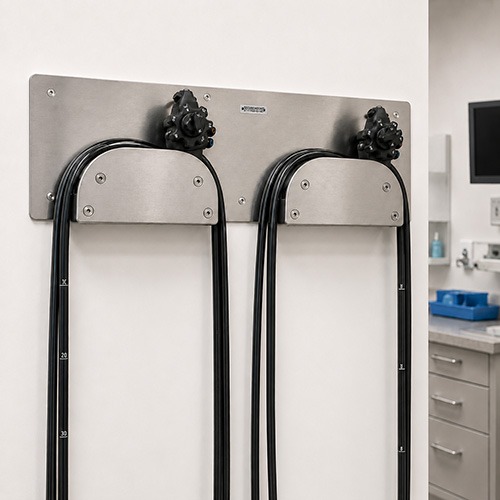
Endoscope Storage and Organization: Choosing a Secure Hanger or Holder
Endoscopes are valuable, delicate instruments that require careful handling before, during, and after use. Although cleaning, disinfection, transport, and storage procedures vary by facility and equipment type, every healthcare organization benefits from having a clear, consistent method for keeping endoscopes supported and organized.
A secure endoscope hanger or holder gives staff a designated place to position equipment rather than relying on improvised hooks, overcrowded counters, or unsuitable storage areas. The right solution can help protect instruments from unnecessary contact, make equipment easier to locate, and support more orderly procedure rooms and reprocessing areas.
Choosing an endoscope storage solution involves more than finding a convenient hook. Healthcare teams must consider the type of instrument being supported, the available mounting space, the surrounding workflow, cleaning requirements, and how easily staff can access the equipment without placing stress on sensitive components.
Why Endoscope Storage and Organization Matter
Endoscopes may be used across multiple procedure rooms, departments, and clinical environments. Between uses, they must be handled in accordance with facility policies, manufacturer instructions, and applicable reprocessing procedures.
Without an established storage and organization system, instruments may be:
- Placed on crowded work surfaces
- Hung from unsuitable equipment
- Stored where they contact walls, floors, or nearby objects
- Positioned in ways that place pressure on tubing or connectors
- Difficult for staff to locate quickly
- Mixed with unrelated devices or accessories
A dedicated endoscope holder creates a predictable location for the instrument. This makes the storage area easier to manage and helps staff recognize when equipment has not been returned to its proper position.
Consistent storage is especially valuable in busy environments where multiple employees share equipment and procedure rooms must be prepared between patients.
The Risks of Improvised Endoscope Storage
Improvised storage methods may appear convenient, but they can create avoidable problems. An endoscope draped over equipment, placed on a counter, or hung from an unsuitable hook may be exposed to excessive bending, impact, or contact with surrounding surfaces.
These arrangements can also contribute to clutter. When endoscopes, cables, accessories, and other equipment occupy the same limited space, staff may need to move several items before accessing the instrument they need.
A secure endoscope hanger helps reduce this uncertainty by providing a defined support point. The goal is to keep the instrument accessible while avoiding unnecessary strain or contact.
Healthcare facilities should always follow the endoscope manufacturer’s instructions for handling and storage. A hanger or holder should support those established procedures rather than replace them.
Endoscope Hanger vs. Endoscope Holder
The terms endoscope hanger and endoscope holder are often used interchangeably, but they can describe several types of equipment.
An endoscope hanger typically provides an elevated support point from which an instrument or component can hang. Depending on the application, it may attach to a wall, equipment rail, mobile stand, pole, or other mounting surface.
An endoscope holder may refer more broadly to any accessory that supports, positions, or organizes an endoscope. Some holders are designed for temporary positioning near the point of use, while others are incorporated into dedicated storage or reprocessing systems.
When evaluating options, the name of the product is less important than whether its design matches the intended application.
Facilities should confirm:
- What portion of the endoscope the hanger is designed to support
- Whether it is intended for temporary organization or longer-term storage
- How it attaches to existing equipment
- Whether the instrument can be positioned without excessive bending
- Whether staff can access it without pulling on cables or tubing
- Whether the holder can be cleaned according to facility procedures
Choose a Hanger That Provides Secure Support
The primary purpose of an endoscope hanger is to provide stable support. A poorly designed holder may allow the instrument to slip, rotate, or contact nearby equipment.
A secure design should hold the intended component consistently without requiring staff to force it into position. The support surface should be appropriate for the shape and size of the equipment being held.
Facilities should also consider how the hanger responds when nearby equipment is moved or bumped. In mobile or crowded environments, a holder must remain secure under normal daily use.
The mounting method is equally important. A hanger attached to a pole or equipment stand should remain firmly positioned and should not slide or rotate unexpectedly.
Consider Instrument Size and Compatibility
Endoscopes and related accessories vary in size, shape, and configuration. A hanger that works well for one instrument may not be appropriate for another.
Before selecting a holder, healthcare teams should review the dimensions and support requirements of the equipment that will be stored. The hanger should provide enough clearance to prevent the instrument from resting against nearby walls, shelves, or devices.
Compatibility considerations may include:
- Instrument diameter and shape
- Length and flexibility of connected tubing
- Connector placement
- Required bend radius
- Available vertical clearance
- Distance from other equipment
- Mounting surface dimensions
Biomedical engineering, clinical staff, infection prevention teams, and equipment manufacturers may all provide useful input during the selection process.
Evaluate the Available Mounting Location
The best hanger design will not be effective if it is installed in an unsuitable location. Placement should reflect how staff use and move through the room.
A hanger should be easy to reach without blocking walkways, work surfaces, or access to other equipment. It should also be positioned where the endoscope can hang freely without contacting the floor or creating an obstruction.
Common mounting locations may include:
- Walls
- Medical equipment rails
- Mobile equipment stands
- Procedure-room workstations
- Storage systems
- Utility poles or equipment poles
Wall-mounted options may be appropriate when the instrument is consistently used in one room. Equipment-mounted holders may provide more flexibility when devices move between areas.
The selected location should support the existing workflow rather than require staff to work around the holder.
Support Cleaning and Infection-Control Procedures
Endoscope storage accessories must fit within the facility’s cleaning and infection-control processes. Complex shapes, tight crevices, or difficult-to-reach mounting points can make routine cleaning more challenging.
A well-designed holder should be made from materials appropriate for the intended healthcare environment and compatible with approved cleaning methods. It should also be positioned so environmental services or clinical staff can access the surrounding surfaces.
Facilities should follow the product manufacturer’s cleaning recommendations and include the hanger in routine inspection schedules.
The holder itself should be checked for:
- Surface damage
- Loose mounting hardware
- Bending or deformation
- Residue or buildup
- Wear that could affect stability
- Contact points that are difficult to clean
If damage is identified, the holder should be evaluated and replaced as necessary.
Improve Accessibility Without Creating Clutter
Endoscope organization should make instruments easier to access while keeping them out of the way when they are not being used.
An effective hanger helps create a balance between accessibility and control. Staff should be able to retrieve or return the instrument without reaching across other equipment or disturbing nearby supplies.
The holder should not interfere with device controls, power cords, tubing, cabinets, doors, or patient movement. In compact procedure rooms, careful placement is particularly important.
A designated storage position also helps reduce visual clutter. When equipment has a consistent location, work areas are easier to evaluate and prepare.
Standardize Endoscope Organization Across Rooms
Healthcare systems often operate multiple procedure rooms with similar equipment. If every room uses a different storage arrangement, staff may need to adapt each time they move between locations.
Standardizing endoscope hanger placement can create more predictable workflows. Facilities may establish guidelines covering:
- Approved holder models
- Mounting height
- Location within the room
- Equipment compatibility
- Cleaning procedures
- Inspection frequency
- Staff responsibilities
Consistent setups make it easier to train employees, complete room checks, and identify missing or misplaced equipment.
Standardization can also simplify purchasing and replacement. Rather than maintaining several unrelated storage products, a facility may be able to use a common solution across compatible rooms and departments.
Include Hangers in Routine Equipment Inspections
An endoscope hanger may be a relatively simple accessory, but it should still be included in regular equipment reviews.
Staff should confirm that the holder remains securely attached and that it supports the instrument as intended. Mounting hardware can loosen over time, particularly on mobile equipment that is frequently moved.
Routine checks can identify problems before the holder becomes unstable or unusable.
Inspection procedures may include:
- Confirming that mounting hardware is secure
- Checking for bent or damaged components
- Verifying that the holder remains properly aligned
- Ensuring the instrument does not contact surrounding surfaces
- Confirming that the holder can be cleaned effectively
- Reviewing whether the location continues to meet workflow needs
Documented inspections can be incorporated into broader equipment maintenance programs.
Choosing the Right Endoscope Hanger for Your Facility
The right storage solution will depend on the equipment, mounting environment, and clinical workflow. Hospitals should avoid selecting a hanger based solely on price or appearance.
A suitable endoscope holder should provide:
- Stable support
- Compatibility with the intended equipment
- Appropriate clearance
- Accessible placement
- Durable construction
- A cleanable design
- Secure mounting
- Integration with existing room layouts
Secure Mount’s endoscopic hanger is designed to provide a dedicated support location within healthcare equipment setups. Facilities evaluating an endoscope storage solution should review the product specifications and confirm that the hanger matches their instruments, mounting surfaces, and organizational requirements.
Create a More Consistent Endoscope Storage Strategy
Endoscope organization is an important part of maintaining orderly procedure rooms, storage areas, and equipment setups. A secure hanger or holder gives staff a designated place for the instrument, reducing reliance on temporary or improvised storage methods.
By considering compatibility, mounting location, stability, accessibility, and cleaning requirements, healthcare facilities can choose a solution that supports their established handling procedures.
Standardizing the use and placement of endoscope holders can further improve consistency across departments. When every instrument has a defined location, equipment is easier to find, workspaces remain more organized, and staff can identify storage problems more quickly.
Contact Secure Mount to learn more about endoscope hangers and medical equipment organization solutions for healthcare environments.