

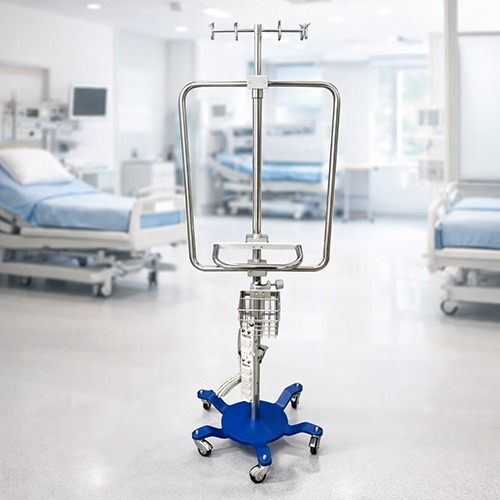
Hospital IV Pole Accessories: Essential Attachments for More Efficient Patient Care
IV poles are used throughout hospitals to support infusion pumps, fluid bags, monitoring equipment, and other devices that need to remain close to the patient. Although the pole itself provides the basic structure, the right IV pole accessories can make the equipment more organized, easier to move, and better suited to the needs of each clinical department.
Attachments such as baskets, clamps, cable holders, power-strip mounts, and equipment supports allow healthcare facilities to configure IV poles for different applications. Selecting these accessories carefully can help reduce clutter, improve access to supplies, and create more consistent equipment setups across patient rooms, treatment areas, and mobile care environments.
The best configuration depends on how the pole will be used, what equipment will be attached, and how often the entire setup must be moved.
Why IV Pole Accessories Matter
A standard IV pole may begin with only a base, vertical shaft, and hooks for fluid bags. In practice, clinical teams often need the pole to support much more.
Infusion pumps may require power connections. Cables and tubing must be routed so they remain accessible without becoming tangled. Staff may also need a location for lightweight supplies, personal items, monitoring components, or other approved materials.
Without appropriate attachments, these items may be placed on nearby counters, draped over equipment, or stored in inconsistent locations. This can add clutter and make the equipment more difficult to prepare, inspect, and move.
Well-selected accessories can help facilities:
- Create more organized mobile equipment setups
- Keep approved supplies near the point of use
- Reduce loose cords and accessories
- Improve access to frequently used items
- Standardize IV pole configurations
- Make equipment checks more efficient
- Adapt poles for different departments and applications
Accessories should support established clinical procedures without obstructing controls, tubing, cables, or staff movement.
IV Pole Baskets for Accessible Storage
Baskets are among the most practical IV pole attachments because they add storage without requiring a separate cart or cabinet. An IV pole basket can move with the patient and equipment, helping keep selected items together as the pole is repositioned.
Depending on facility policy and basket design, it may hold packaged supplies, cable-management components, monitoring accessories, or personal belongings. The basket should be sized for its intended contents and mounted where staff can reach it without interfering with pumps or tubing.
An oversized basket can make the pole harder to maneuver, while a basket that is too small may quickly become overcrowded. Facilities should also confirm the basket’s load capacity and make sure the added weight will not affect pole stability.
Secure Mount offers several medical storage baskets that can be incorporated into healthcare equipment configurations. Stainless steel wire designs are often useful because they provide visibility, airflow, and durable construction for routine clinical use.
Universal Pole Clamps for Flexible Mounting
Many hospital IV pole accessories depend on a secure mounting point. Pole clamps make it possible to attach baskets, holders, equipment supports, and other components to the vertical shaft.
A universal pole clamp can provide flexibility when facilities need to adapt accessories to different pole configurations. The clamp should fit the pole diameter, remain stable during normal movement, and resist sliding or rotating when the attached accessory is used.
Placement is important. Multiple clamps installed too close together can compete for space or interfere with pump brackets, controls, cables, and power connections. Biomedical engineering teams should review the full equipment layout before approving an accessory position.
The mounting hardware should also be included in routine inspections. Loose fasteners, damaged clamps, or shifting accessories can affect the usability of the entire IV pole setup.
Cable Holders and Cord-Management Accessories
Modern IV poles may support several powered devices, creating multiple cords and cables around the equipment. Without a defined routing system, cords can hang loosely, become tangled, or make the pole more difficult to move.
Cable holders and cord-management accessories give staff designated places to secure or route cables. These attachments can help keep cords closer to the equipment and make them easier to identify during setup and inspection.
The accessory should hold the cable without placing excessive pressure on connectors or creating tight bends. It should also allow staff to remove or reposition the cable when necessary.
Cable-management components are most effective when their placement is standardized. When similar IV poles use the same cable-routing layout, staff can more quickly identify disconnected, misplaced, or incorrectly routed cords.
Power-Strip Mounts and Electrical Organization
Infusion pumps and other devices attached to an IV pole may require access to electrical power. A properly selected mounting system can keep an approved power strip secured to the pole rather than resting on the floor or hanging from a cord.
The electrical components used in patient care areas must meet the facility’s requirements and applicable standards. Facilities should involve biomedical engineering, clinical engineering, or electrical safety personnel when selecting and installing power-related accessories.
A power-strip mount should keep the device accessible without blocking outlets or interfering with the pole base. Power cords should be routed to reduce excess slack while still allowing the equipment to move as intended.
The mount, power strip, plugs, and cords should be inspected regularly for damage, looseness, or signs of wear.
Equipment Holders and Specialized Attachments
Some departments require more specialized IV pole accessories. These may include holders for small medical devices, vials, suction accessories, monitoring components, or procedure-specific equipment.
For example, a medical vial holder can create a defined location for small containers that might otherwise be placed loosely on a tray. Other holders may support approved devices or accessories that need to remain close to the patient.
Before adding a specialized attachment, facilities should confirm that it is compatible with the equipment and suitable for the intended workflow. A holder should provide stable support without obscuring labels, displays, controls, or connection points.
It should also be positioned so staff can retrieve and return the item without pulling on nearby cables or tubing.
Hooks and Hangers for Clinical Equipment
Hooks and hangers can provide simple support for lightweight accessories, bags, or approved equipment components. However, not every hook is suitable for every application.
Facilities should consider the size, shape, load, and method of attachment. The hanger must remain secure and should not create a sharp projection or obstruction. Items should not be hung in a way that affects the balance of the IV pole or places stress on sensitive tubing and connectors.
Specialized holders, such as endoscope hangers, should be evaluated according to the requirements of the equipment being supported. Improvised hooks or temporary storage methods may not provide the necessary stability or clearance.
Choosing Accessories for Heavy-Duty IV Poles
The number and weight of accessories should be matched to the capacity of the pole. A heavy-duty IV pole may be appropriate when the setup includes multiple pumps, power equipment, baskets, or other attachments.
Even with a heavy-duty design, facilities should distribute weight carefully. Mounting several heavy components on one side or placing them too high on the shaft may affect balance and maneuverability.
The pole base, casters, shaft, clamps, and accessories should be evaluated as one complete system. Adding attachments individually without considering the full configuration can result in overcrowding or poor weight distribution.
Cleaning and Inspection Requirements
IV pole accessories must fit within the hospital’s cleaning and equipment-maintenance procedures. Baskets, clamps, holders, and mounting brackets can collect dust or residue and may include areas that require additional attention.
Facilities should establish clear procedures for:
- Cleaning accessory surfaces and mounting points
- Inspecting clamps and fasteners
- Checking baskets for bent wires or damaged welds
- Identifying sharp edges or surface deterioration
- Verifying that holders remain properly aligned
- Confirming that cables and tubing are not pinched
- Removing damaged accessories from service
Materials should be compatible with approved cleaning products, and manufacturer instructions should be followed.
Standardizing IV Pole Configurations
Standardization can improve efficiency across departments. When similar poles use the same accessories in the same locations, staff know where to find supplies, how to route cables, and what to inspect before use.
Healthcare facilities can document approved configurations based on department or application. A standard may identify the pole model, accessory types, mounting heights, load limits, and cleaning requirements.
Clinical staff and biomedical engineering teams should both be involved in the process. Clinical employees can explain daily workflow needs, while technical teams can evaluate compatibility, stability, and maintenance requirements.
Creating a More Efficient Mobile Equipment Setup
Hospital IV pole accessories can turn a basic pole into a more organized and functional equipment platform. Baskets add accessible storage, clamps provide secure mounting points, cable holders improve cord organization, and specialized attachments support department-specific needs.
The most effective setup is not necessarily the one with the most accessories. Each attachment should serve a defined purpose and fit safely within the available space and weight capacity.
Facilities evaluating new configurations can review Secure Mount’s selection of IV poles and accessories for options designed to support organized clinical equipment setups.
Contact Secure Mount to discuss IV pole accessories, mounting solutions, baskets, and customized equipment configurations for healthcare facilities.