

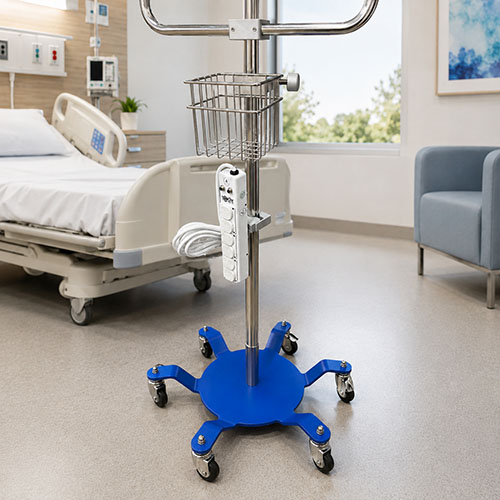
IV Pole Cable Management Best Practices for Patient Rooms and Mobile Equipment
Patient care environments depend on mobility. IV poles, infusion pumps, monitoring devices, and other equipment must move easily with patients while remaining organized, functional, and safe. However, as more devices are added to mobile equipment setups, cable management becomes increasingly important. Without proper organization, cords can become tangled, damaged, disconnected, or create hazards for both patients and staff.
Effective IV pole cable management helps healthcare facilities maintain cleaner patient rooms, improve equipment reliability, and support more efficient workflows. By implementing standardized cable management practices, hospitals can reduce clutter, improve safety, and create a more organized care environment.
Why IV Pole Cable Management Matters
IV poles serve as mobile workstations throughout hospitals, clinics, and healthcare facilities. In many cases, a single pole may support multiple devices, including infusion pumps, power strips, battery systems, monitoring equipment, and associated cables.
As these systems become more complex, unmanaged cords can create several challenges:
- Cables can become tangled during transport
- Power cords may become disconnected accidentally
- Equipment setups can vary between rooms and departments
- Loose cords can create tripping hazards
- Cleaning and disinfection become more difficult
- Cables may experience excessive wear and damage
Without a consistent approach to cable management, these issues can impact both efficiency and patient safety.
The Benefits of Organized IV Pole Cord Management
A well-organized IV pole setup delivers benefits that extend beyond appearance. Proper cable management helps ensure equipment remains operational, accessible, and easy to maintain.
Key benefits include:
- Improved equipment reliability
- Faster patient room setup and turnover
- Enhanced patient and staff safety
- Better infection control compliance
- Reduced cable replacement costs
- More professional and organized care environments
These improvements can have a meaningful impact on day-to-day operations throughout a healthcare facility.
1. Standardize IV Pole Configurations
One of the most effective ways to improve cable management is to standardize how IV poles are configured across departments.
When poles are organized consistently, clinical staff can quickly identify equipment locations, trace cables, and verify connections. Standardization also reduces training requirements and minimizes confusion when equipment moves between units.
Hospitals should establish guidelines for:
- Cable routing paths
- Power strip placement
- Pump positioning
- Cord attachment methods
- Accessory locations
Creating repeatable setups improves both efficiency and reliability.
2. Secure Cables Close to the Pole
One of the primary goals of IV pole cable management is keeping cords close to the equipment structure. Loose hanging cables are more likely to become tangled, snagged, or damaged during transport.
Securing cables to the pole helps:
- Reduce cable movement
- Prevent accidental disconnections
- Minimize wear and tear
- Improve overall organization
When cables remain controlled and properly routed, equipment is easier to move throughout patient care areas.
3. Support Safe Mobility
IV poles are designed to move. Whether transporting patients between departments or repositioning equipment within a room, mobility is a critical requirement.
Poor cable management can interfere with that mobility. Long cords may drag across floors, become caught on furniture, or wrap around wheels and equipment.
Facilities should regularly evaluate mobile equipment setups to ensure cables remain secure during movement. This helps prevent disruptions while protecting both staff and patients.
4. Consider Heavy-Duty Equipment for High-Acuity Areas
Critical care environments often require IV poles that support multiple devices and heavier equipment loads.
Using purpose-built solutions such as a Heavy Duty IV Pole helps ensure stability while providing a strong foundation for organized cable management. These systems are designed to support demanding clinical environments where multiple pumps, power accessories, and monitoring devices may be mounted to a single pole.
A stable equipment platform makes it easier to maintain consistent cable routing and organization.
5. Improve Infection Control Through Better Organization
Cable clutter can make cleaning more difficult. Cords that overlap, hang loosely, or rest against multiple surfaces create additional contact points that require attention during disinfection procedures.
Well-organized IV pole setups support infection control efforts by:
- Improving access during cleaning
- Reducing cable contact with floors
- Limiting tangled surfaces
- Creating more predictable equipment layouts
As healthcare facilities continue to prioritize infection prevention, cable management remains an important part of maintaining clean patient care environments.
6. Conduct Regular Equipment Audits
Even the best cable management systems require ongoing maintenance. Equipment is frequently moved, adjusted, and reconfigured throughout daily operations.
Regular audits can help identify:
- Damaged cables
- Loose attachments
- Inconsistent setups
- Potential safety concerns
Routine inspections help maintain standards and ensure equipment remains organized over time.
Choosing the Right IV Pole Solutions
Not all IV poles are designed for the same applications. Facilities should evaluate their equipment requirements carefully when selecting solutions.
Factors to consider include:
- Number of mounted devices
- Power management needs
- Mobility requirements
- Accessory compatibility
- Stability requirements
Secure Mount offers a variety of IV pole solutions designed to support modern healthcare environments. Selecting the right platform can simplify cable management while improving equipment functionality.
Building a More Organized Patient Care Environment
Effective cable management for IV poles is about much more than appearance. Proper organization supports patient safety, improves staff efficiency, enhances infection control efforts, and helps maintain reliable equipment operation.
By standardizing configurations, securing cables, supporting mobility, and investing in appropriate equipment, healthcare facilities can create cleaner and more efficient patient care environments.
Start Improving Your IV Pole Cable Management Strategy
If your facility is looking to improve equipment organization, reduce cable clutter, and enhance workflow efficiency, now is the time to evaluate your current IV pole setups.
Contact Secure Mount to learn more about IV pole solutions and cable management systems designed specifically for healthcare environments.