

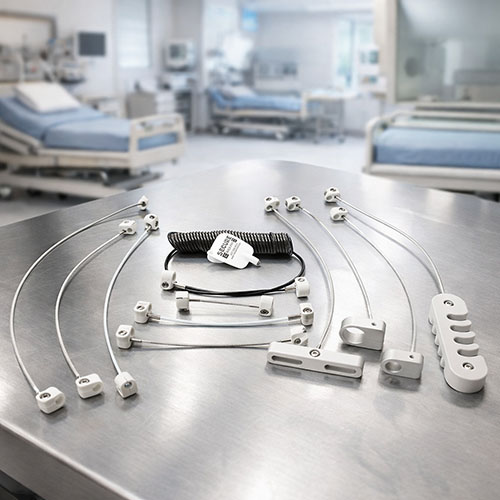
Medical Cable Tethers and How Hospitals are Standardizing Them
As hospitals look for ways to improve efficiency and reduce equipment-related issues, one simple solution is gaining widespread adoption: medical cable tethers. These systems are designed to keep essential cables connected, organized, and accounted for—addressing a common but costly challenge in healthcare environments. By securing cables directly to equipment, facilities can eliminate many of the frustrations associated with missing or misplaced components while creating more consistent workflows across departments.
Medical cable tethers have emerged as a practical and effective solution to these challenges. By securing cables directly to equipment, healthcare facilities can maintain organization, reduce loss, and improve workflow consistency. As a result, many hospitals are now standardizing cable tether systems across departments.
What Are Medical Cable Tethers?
Medical cable tethers are secure attachment systems designed to keep cables physically connected to medical equipment. Typically constructed with a stainless-steel braided core and a durable outer coating, these tethers are built to withstand the demands of hospital environments, including frequent cleaning and disinfection.
Most cable tethers feature secure locking mechanisms that prevent accidental removal or tampering, while still allowing authorized staff to detach cables when necessary using a specialized key. This balance of security and accessibility makes them ideal for healthcare settings where both reliability and flexibility are critical.
Why Cable Loss Is a Growing Challenge in Hospitals
In busy healthcare facilities, cables are constantly being moved between rooms, devices, and departments. During routine cleaning, patient transfers, or equipment repositioning, cables can easily become disconnected or misplaced.
This creates several operational challenges:
- Missing cables can delay patient care and equipment use
- Staff may spend unnecessary time searching for components
- Frequent replacements increase operational costs
- Inconsistent setups can lead to confusion or errors
Why Hospitals Are Standardizing Cable Tether Systems
Healthcare facilities are increasingly adopting standardized cable tether systems as part of broader cable management strategies.
1. Improved Equipment Accountability
When cables are tethered directly to equipment, they remain physically attached and accounted for at all times. This eliminates the common issue of cables being removed, misplaced, or unintentionally transferred between devices or rooms. Clinical teams can trust that each piece of equipment is complete and ready for use, reducing delays and frustration. Over time, this improved accountability also makes it easier to track assets, identify missing components quickly, and maintain consistent equipment readiness across departments.
2. Faster Room Turnover and Setup
Cable tethers play a critical role in improving room turnover efficiency. Because cables remain attached to their designated equipment, staff no longer need to search for or reconnect missing components during patient transitions. This allows for faster cleaning, quicker setup, and reduced downtime between patients. In high-acuity environments like emergency departments and ICUs, these time savings can have a direct impact on patient flow and care delivery.
3. Consistent Cable Organization Across Departments
Standardizing cable tether use across rooms and departments creates a uniform equipment setup that staff can rely on. Whether a nurse or technician is working in one unit or another, they can expect the same cable configuration and organization. This consistency reduces training requirements and minimizes errors. Pairing tethers with tools like a 4 place cable holder further improves organization by keeping cables neatly positioned, easy to access, and free from tangling.
4. Enhanced Infection Control
Proper cable organization supports infection control efforts by reducing clutter and improving cleanability. When cables are secured and routed correctly, environmental services teams can more easily access surfaces and disinfect equipment thoroughly. Tether systems help prevent cables from resting on floors or becoming entangled, both of which can increase contamination risk. Many tethers are designed with materials that withstand hospital-grade cleaning agents, making them well-suited for strict hygiene protocols.
5. Reduced Costs Over Time
Lost and damaged cables represent a recurring expense for healthcare facilities. By implementing cable tether systems, hospitals can significantly reduce replacement frequency and extend the usable life of their equipment. While the upfront investment in tethers is minimal, the long-term cost savings can be substantial. Additionally, fewer missing components mean less downtime and more efficient use of existing equipment.
Enhancing Cable Identification with Color Coding
Color-coded cable tethers add an additional layer of organization by making it easy to visually identify cables associated with specific devices, rooms, or departments. This reduces the likelihood of setup errors and speeds up equipment verification. In fast-paced clinical environments, being able to quickly confirm correct connections improves both efficiency and patient safety. Color coding also supports standardization initiatives by reinforcing consistent practices across teams.
Integrating Cable Tethers into a Larger Strategy
While cable tethers provide immediate benefits, they are most effective when integrated into a broader cable management strategy. Combining tethers with cable holders, routing systems, and standardized workflows creates a comprehensive solution that addresses organization, security, and efficiency. Facilities that take this holistic approach can achieve long-term improvements in equipment management, staff productivity, and patient care environments.
Start Standardizing Your Cable Management Approach
Medical cable tethers offer a simple, scalable way to improve cable organization and reduce loss across healthcare facilities. By standardizing these solutions, hospitals can create more efficient workflows, reduce costs, and maintain cleaner, safer patient environments. To learn more about implementing cable tether systems in your facility, contact Secure Mount and explore solutions tailored to your needs.